Roberto Mancini probably regrets stating that only players born in Italy should be eligible to represent the Azzurri.
He made the infamous proclamation as coach of Inter in March 2015, also declaring that even those with Italian relatives should not be considered for Italy.
The national team coach has clearly changed his way of thinking as he relied on three Brazilian-born players – Jorginho, Emerson Palmieri and Rafael Tolói – as Italy clinched a brilliant European Championship victory against England at Wembley in July 2021.
Now the Azzurri face off against Copa America champions Argentina in the Finalissima, on the same pitch Mancini guided Italy to a memorable Euro 2020 triumph last summer.
The clash of the continental champions will bring together several players with a shared heritage.
It is estimated that around 3 million Italians emigrated to Argentina in the late 19th and early 20th centuries, many settling in and around the capital Buenos Aires.
A common love of football united both nations and a select few went on to represent the country of their birth and of their ancestors.
The controversial selection of Oriundi – players who were not born in Italy but qualify through family heritage – continues to be a polarising subject.
Constant rule changes and political meddling shaped the international futures of many players born in the South American country but with familial connections to Italy.
Four Argentine-born players were in the Italy squad which won the World Cup in 1934 – Atilio José Demaría, Raimundo Orsi, Luis Monti, and Enrique Guaita.
The quartet had all played for Argentina before becoming dual nationals.
Ex-Juventus midfielder Monti holds the unique record of playing in World Cup finals for different nations; he started for Argentina as they lost in the inaugural 1930 competition to hosts Uruguay before claiming the sport’s most prestigious prize with the Azzurri four years later.
Juventus forward Orsi – who won five consecutive Serie A titles with the Old Lady – netted against Czechoslovakia in the 1934 final for Italy in Rome, carving a path for others to follow.
Success tends to quiet the dissenters and inevitably played a role in multi-talented attacker Omar Sívori being capped for the Azzurri. Sivori, Humberto Maschio (Bologna) and Antonio Valentín Angelillo (Inter) – christened the Angels with Dirty Faces after the movie of the same name – were all recruited by Italian clubs after winning the 1957 South American Championship with Argentina. The attacking trio were subsequently banned from playing for their native country but all wore the famous blue shirt of Italy.
Juventus legend Sivori – who won three Serie A titles and the Ballon d’Or while at the Bianconeri – was the most successful of the three and netted eight times in nine matches for the Azzurri between 1961-62.
Regulations and attitudes towards foreign based players altered throughout the 1970s and 1980s. Although Diego Maradona had Italian ancestry on his mother’s side, the greatest of all time was always destined to become an iconic symbol for the Argentinian national team.
It was not until the unlikely emergence of Mauro Camoranesi that an Argentina-born player became another high-profile Azzurri contributor.
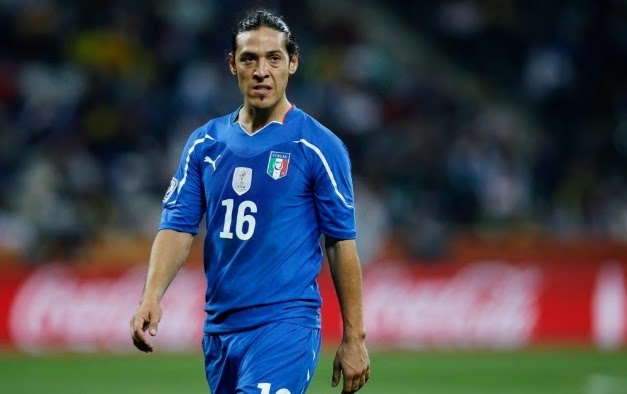
The Juventus winger qualified for Italy through his great-grandfather and although his selection divided opinion and provoked heated debate, he was capped 55 times in a seven year spell between 2003 and 2010, scoring four goals. Camoranesi will be most remembered for the part he played in Italy’s incredible 2006 World Cup victory as part of Marcello Lippi’s squad.
The clamour to find any tenuous Italian link to the very best Argetinian players, inevitably fuelled by the popularity of social media, continued in the decades that followed.
Once in a generation playmaker Lionel Messi was eligible to play for Italy as the result of a great-grandfather from the region of Marche but was not approached by the Italian Football Federation.
Paris Saint-Germain striker Mauro Icardi rejected an invitation to play for the Italy under-19 squad in 2012 and was subsequently called up by Argentina.
Paulo Dybala never intended to choose the Azzurri over his native country despite his great-grandmother hailing from Napoli. The former Palermo and Juventus forward was also able to play for Poland through his grandfather but always considered himself Argentinian.
Instead, some other less recognisable names were given the honour of featuring for the Azzurri.
Guitar playing maverick Dani Osvaldo – born in the Argentine city of Lanús – struck four times in 14 games for Italy between 2011 and 2014 in a peripatetic career in which he played for seven Serie A clubs including Fiorentina, Bologna, Roma and Juventus.
Parma attacking midfielder Franco Vázquez bucked the trend by swapping Argentina for Italy. Born in the South American nation to an Italian mother, he was summoned by Azzurri coach Antonio Conte in March 2015 and his call up partly prompted Mancini’s rather patriotic outburst. Vázquez played two friendlies before eventually settling for the country of his birth in 2018 but was never likely to be a key figure for either nation.
Despite the altering of international eligibility rules – players can qualify through five years of residency or swap nations after playing friendlies for another country – there has been a notable absence of Argentinian Oriundi in recent years.
Given Mancini’s recent record of selecting Brazilian born players – Cagliari’s João Pedro and Lazio’s Luiz Felipe the latest non-Italian recruits – he would surely have no hesitation in calling up any talented, qualified Argentine as Italy aim to rebuild after failing to qualify for the last two World Cups.
This article was featured on the Football Italia website on Wednesday, June 1, 2022.
 Stephen Kasiewicz